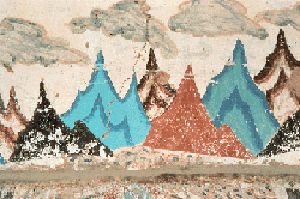
Mountains, east slope of ceiling (pl. 32)
Cave 285, which has inscriptions dated 538 and 539, is of considerable size, 6.4 metres wide, 5.9 metres deep and 4.3 metres high. Like cave 249, it has a pyramidal ceiling with a flat central area, providing generous surfaces for ornament and imager. As well as being one of the very few precisely dated caves, it also has the distinction of being the largest of the three monastery-type caves at Dunhuang, corresponding to the rock-cut monasteries at Ajanta in India. The mural decoration of the whole of the cave is extremely innovative and unusually well preserved, with brilliant undimmed colouring and lively depictions. Different schemes are seen on the four walls and the ceiling...
...Like cave 249, the four sloping faces of the ceiling show figures and strange creatures in a sky full of scudding wisps of cloud (pls 31, 34). At the centre of the eastern slope, above a range of sharply pointed peaks (pl. 32 - above), two figures of wrestlers support a flowering stem crowned by a cintamani jewel (pl. 31). Another such jewel, without supporting figures, is seen in the centre of the southern slope. The theme is very similar to the pair of wrestlers on the eastern slope of the ceiling in cave 288, where the jewel is flanked by Buddhist heavenly beings (pl. 23, top section). In this case, however, the two serpent-tailed beings flying towards the jewel are identifiable as the god Fuxi and the goddess Nüwa, the former holding a set-square and the latter a compass (pls 272, 274). In the Han dynasty and for some centuries thereafter, Fuxi and Nüwa were often depicted as a married couple, with serpentine lower bodies entwined with each other...
Many other creatures from the ceiling slopes are also shown in detail (pls 271284). They include various winged ghosts and spirits (pls 273, 275 - see detail below); the human-headed Longevity bird (pl. 279); other birds and phoenixes, some with Daoist immortals riding on them (pls 280, 281); and one of the thunder gods from the west slope (pl. 271)...

Heavenly Being, east slope of ceiling (detail from pl. 275)
...The programme of the west wall (pl. 42) is perhaps the most complex and diverse of all the Dunhuang caves. The central niche is fully 1 metre deep, 2 metres wide, and 2.6 metres high, but its apparent height and width are greatly increased by the lintel above, which extends on to the west slope of the ceiling, where monkeys play among the hills (pls 282, 283). This lintel is filled with scrolling half-palmettes and lotus blooms, alternately red and blue, inverted and right way up, each with a small figure representing a Bodhisattva newly reborn by transformation (pl. 211). Within this niche, the main image is seated with legs pendent (pl. 43). The Buddha's robe gives a glimpse of the fastening of his inner garment, and hangs over the throne and his legs in raised spiral folds which are consummately modelled. It ends in elegant points at the Buddha's left shoulder. The halo and aureole are wholly composed of up to six different kinds of flame borders, perhaps the most elaborate from the entire site. Similarly, the rows of adoring Bodhisattvas, slim and beautiful, with haloes all of different colours, show the highest level of skill (pl. 242). At the top of the niche, four apsarasas or heavenly beings exemplify this artistry; they are drawn with fine ink lines, colour shading of the contours, and fine white highlights, their graceful antics neatly filling the curved surface and directing attention back to the Buddha (see detail below)...
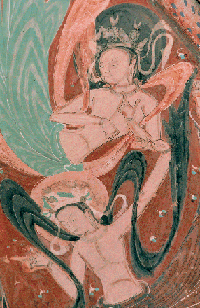
Heavenly Beings, north side of niche in west wall
...The landscape settings in this cave are particularly striking. The meditational theme of the whole cave required the hermits in their solitary cells to be depicted in remote surroundings, with wild animals and birds completely at ease with their presence, and this has led to some delightful inventions. The hermits themselves are seated on the ground, on chairs or stools, or on lotus pedestals. Their cells often have a lintel or border with scrolling decoration, while the hills are striped in vivid colours to give an indication of distance and recession, and crowned with trees. All kinds of animals and birds, some drawn in fluent ink outline only, come and go in these surroundings.
The overall intent of the iconography of this cave is evidently closely identified with the practice of meditation, implicit in the architecture, sculpture and paintings. The latter comprise three kinds: hieratic (the Seven Buddhas of the Past and Sakyamuni on the north wall), landscape (the hermits in their cells at the top of the walls) and narrative (the scenes on the south wall above and between the niches, which contain several references to meditation). On the ceiling and the west wall, motifs from Chinese legend and non-Buddhist Indian deities are depicted in order to demonstrate and reinforce the power of Buddhism.